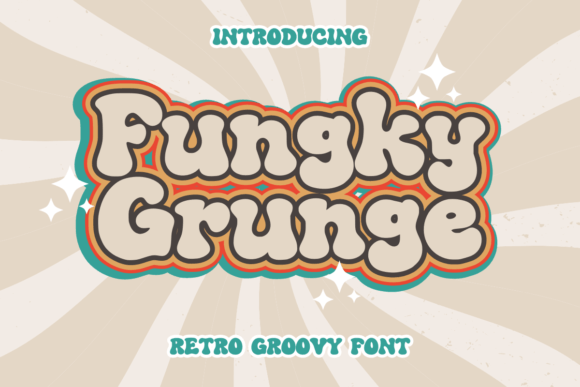
Fungky Grunge: A Playful Display Font for Memorable Branding
As a small business owner who designs most of my own marketing materials—from product labels and Instagram stories to café menus and thank-you cards—I’ve learned that typography isn’t just about looking pretty. It’s about showing up consistently, clearly, and authentically across every customer touchpoint. That’s why I was immediately drawn to Fungky Grunge: a display font that balances cheerfulness with clarity, and personality with professionalism.
Fungky Grunge is a playful, hand-drawn-inspired typeface with subtle grunge texture—just enough to feel warm and human, not so much that it sacrifices legibility. Its rounded forms, slight bounce, and friendly irregularities give it a lighthearted, approachable energy. Think of it as the visual equivalent of a smile in your brand voice: inviting, sincere, and never trying too hard. It’s not a script font or a strict handwritten typeface—it’s more intentional than that—but it carries the same warmth and charm you’d want when connecting with customers face-to-face.
In practice, Fungky Grunge shines brightest where attention and emotion matter most. Use it for your logo or logotype if your brand leans into joy, creativity, or gentle rebellion—like a boutique selling handmade ceramics, a plant shop with a quirky vibe, or a wellness coach who talks about self-care without sounding clinical. On packaging, it adds instant character to candle labels, soap bars, or snack boxes without overwhelming the design. I used it for my small-batch granola line on front-of-pack headers, and customers regularly comment on how “happy” the branding feels—even before tasting the product.
It works beautifully on physical materials: business cards, postcards, stickers, and flyers hold up well in print because the letterforms are bold and distinct at medium to large sizes. For digital use, it performs reliably in website banners, social media graphics (especially Instagram carousels and Pinterest pins), and email headers—just avoid using it below 24pt for body text or captions. While it’s not meant for long paragraphs, its strength lies in short, high-impact phrases: “New Arrivals,” “Hand-Poured,” “Made With Love,” or your shop name above a menu.
Consistency starts with restraint—and knowing when *not* to use Fungky Grunge is just as important as knowing when to use it. Treat it as your accent font, not your workhorse. Pair it with a clean, highly readable sans serif like Montserrat, Inter, or Open Sans for supporting text, pricing, ingredients, or website navigation. That contrast does two things: it makes your brand feel intentional (not chaotic), and it keeps information scannable across devices—whether someone’s reading your product label in-store or checking your online shop on mobile.
If you lean into more traditional aesthetics—say, a heritage-style bakery or a luxury skincare line—you might pair Fungky Grunge with a soft serif like Merriweather or Lora for secondary headlines or quotes. The key is balance: let Fungky Grunge bring the personality, and let the supporting typeface bring the clarity. This kind of thoughtful font pairing builds trust over time. Customers subconsciously notice when your visuals feel cohesive—not “designed,” but *considered*.
Before rolling it out everywhere, test Fungky Grunge in real contexts. Print a few versions of your product label at actual size—does the texture still read cleanly on matte kraft paper? Try it in your Instagram Stories editor—does it stay legible against busy backgrounds or in thumbnail previews? Load it on your website and check how it renders on both desktop and iOS Safari. Small details like spacing, weight, and rendering behavior change across platforms, and what looks perfect in a design mockup may need minor tweaks in production.
One thing I wish I’d known earlier: licensing matters. Fungky Grunge is a premium font, and while many creators offer personal-use licenses, small businesses need a commercial license to use it on physical products, packaging, merchandise, client projects, or digital templates sold to others. Always double-check the license terms before ordering. Reputable font sellers will clarify usage rights upfront—including whether you can embed it in PDFs, use it in logos you trademark, or include it in Canva templates for sale. Skipping this step could mean redesigning down the line—or worse, receiving an unexpected invoice.
Real-world examples help make it concrete. A local candle maker uses Fungky Grunge for jar labels (“Lavender Daydream,” “Midnight Citrus”) and pairs it with a neutral sans serif for burn instructions and scent notes. A children’s book illustrator chose it for her series title and author name on covers—parents tell her it “feels like storytime.” A freelance graphic designer licenses it for client branding packages, always pairing it with a versatile sans serif to ensure the final identity scales from Instagram bios to printed business cards.
What sets Fungky Grunge apart isn’t just its look—it’s how it helps small businesses communicate tone without words. In a crowded marketplace, your font is part of your first impression. It tells people whether you’re serious or spirited, polished or personable, nostalgic or fresh. Fungky Grunge doesn’t try to be everything—it’s a focused, expressive display font built for moments that deserve a little joy and authenticity.
So if your brand has heart, humor, or handmade energy—and you want that to show up consistently across packaging, social posts, signage, and web visuals—Fungky Grunge is worth trying. Start small: apply it to one high-visibility asset, get feedback from real customers, refine your pairing, and expand thoughtfully. Because great branding isn’t about having the flashiest assets—it’s about building recognition, trust, and connection, one thoughtful detail at a time.