Rollinger: A Display Font That Makes Handmade Details Shine
There’s that quiet moment—early morning light, coffee steaming, laptop open—when you’re tweaking the label for your new lavender-vanilla candle. You’ve got the perfect kraft paper tag, the right ribbon, even the subtle scent strip printed just so. But something’s missing. The type feels flat. Generic. Like it’s whispering instead of welcoming. That’s when I opened my fonts folder, scrolled past the usual suspects, and clicked on Rollinger. Instantly, the design exhaled.
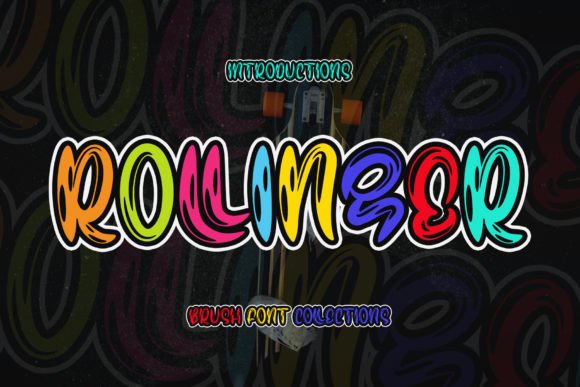
Rollinger is a display font with soft curves, gentle contrast, and a warm, hand-crafted rhythm—like ink gently pressed into textured paper. It’s not fussy or overly ornate, but it carries presence. Think of it as the kind of typeface that leans in during a conversation: confident but kind, elegant but approachable. Its lowercase ‘g’ has a tender loop; its capital ‘R’ sweeps with quiet authority. It doesn’t shout—it invites. And for makers who pour care into every stitch, stamp, and serif, that invitation matters.
I first used Rollinger on a set of seasonal greeting cards—simple folded A6 sheets, letterpress-printed on cotton rag paper. For the front, just two words: “Hello, Spring.” In Rollinger, those words bloomed. Not because they were bigger, but because the spacing, the weight, the subtle personality of each letter made them feel intentional, considered. Customers later told me the cards “felt like a gift before they were even opened.” That’s the quiet power of a well-chosen display font.
Rollinger shines brightest where attention lives: on product labels, boutique tags, wedding welcome boards, printable wall art, and digital download previews. It’s ideal for short, meaningful phrases—“Hand-poured,” “Made with Love,” “Est. 2022,” “Small Batch,” “Farmhouse Fresh”. Its generous x-height and open counters keep it legible even at 14–18pt on jar labels or 24pt on sticker sheets. When cut on a Cricut or Silhouette, Rollinger holds its shape beautifully—no fragile terminals snapping off, no tight corners clogging with vinyl. I tested it on matte black sticker paper for mini herb labels (basil, thyme, rosemary), and every cut was crisp, every curve smooth.
For wedding stationery, Rollinger adds warmth without formality. On a kraft invitation suite, it pairs effortlessly with a clean sans serif—think Montserrat Light for body text and Rollinger for names and dates. No competing energies, just thoughtful contrast. Same goes for planner covers or printable habit trackers: Rollinger as the title, a simple serif like Lora for weekly notes. The result? A cohesive, elevated look that feels handmade—not templated.
It’s also become my go-to for digital printables. When designing a set of printable quote cards for Etsy, I used Rollinger for the main phrase (“Breathe Deeply,” “You Are Enough”) and paired it with a light handwritten font for attribution lines. The combination felt personal, grounded, and quietly luxurious—exactly the mood my customers search for. And because Rollinger includes stylistic alternates and ligatures (like the lovely ‘fi’ and ‘fl’ connections), I could add subtle polish without overdesigning.
That said—Rollinger isn’t meant for paragraphs. It’s a display font, not a workhorse text face. I don’t use it for ingredient lists on soap labels or full-page instructions in a digital workbook. But for titles, headers, quotes, shop name banners, and packaging accents? Absolutely. Its charm lies in restraint. One line, well-set, does more than ten lines trying too hard.
When prepping for physical production, I always double-check a few things before finalizing: Is the file format compatible with my cutting software? (Rollinger comes in OTF and TTF—both work smoothly in Cricut Design Space and Silhouette Studio.) Does it include multilingual characters if I’m adding a French or Spanish variant to a greeting card set? (Yes—it supports extended Latin, including accented vowels and punctuation.) And most importantly: Is the license commercial? Yes—it’s cleared for use on physical products, digital templates, SVG bundles, mugs, tote bags, and shop branding. No hidden restrictions, no surprise fees when scaling from one batch to fifty.
I’ve used Rollinger on everything from rustic wooden signs (“Gather Here”) to minimalist mug designs (“Good Morning, Friend”), from holiday gift tags (“For You, With Joy”) to digital planner cover mockups. Each time, it brings cohesion—not by shouting, but by settling in like it belongs. That consistency builds recognition. When someone sees Rollinger on your candle label, then your Instagram story, then your printable calendar, they begin to associate that graceful rhythm with your brand’s care and craft.
Readability tips I’ve learned along the way: For small stickers (under 1.5 inches wide), stick to 3–4 words max in Rollinger—and avoid tight kerning. For printed cards, print a test sheet first: sometimes the subtle contrast reads softer on uncoated stock, so I’ll bump tracking by +10 or choose the slightly bolder weight if available. And for social media previews? Always preview at actual size on mobile—Rollinger’s charm can get lost in tiny thumbnails if the phrase is too long or the background too busy.
Pairing Rollinger thoughtfully makes all the difference. With a friendly sans serif (like Poppins or Nunito), it grounds modern handmade brands. With a delicate script (say, Pacifico or Quicksand), it adds layered texture—perfect for bridal collections. And with a sturdy serif (like Merriweather or Playfair Display), it creates heirloom-level depth for apothecary or vintage-inspired lines. The key is balance: let Rollinger lead, then support—not compete.
What started as a font search for a candle label turned into a quiet design anchor—one that shows up in my shop banner, my packaging tape stamp, even the title slide of my digital workshop slides. Rollinger doesn’t distract from the handmade details; it honors them. It says, without saying a word: This was made with care. This matters.
If you’re choosing a display font to represent your craft—whether you’re pressing wax, stitching linen, designing digital planners, or curating seasonal kits—look for one that feels like an extension of your hands. Rollinger does that. Not loudly. Not perfectly. But warmly, consistently, and with unmistakable heart.